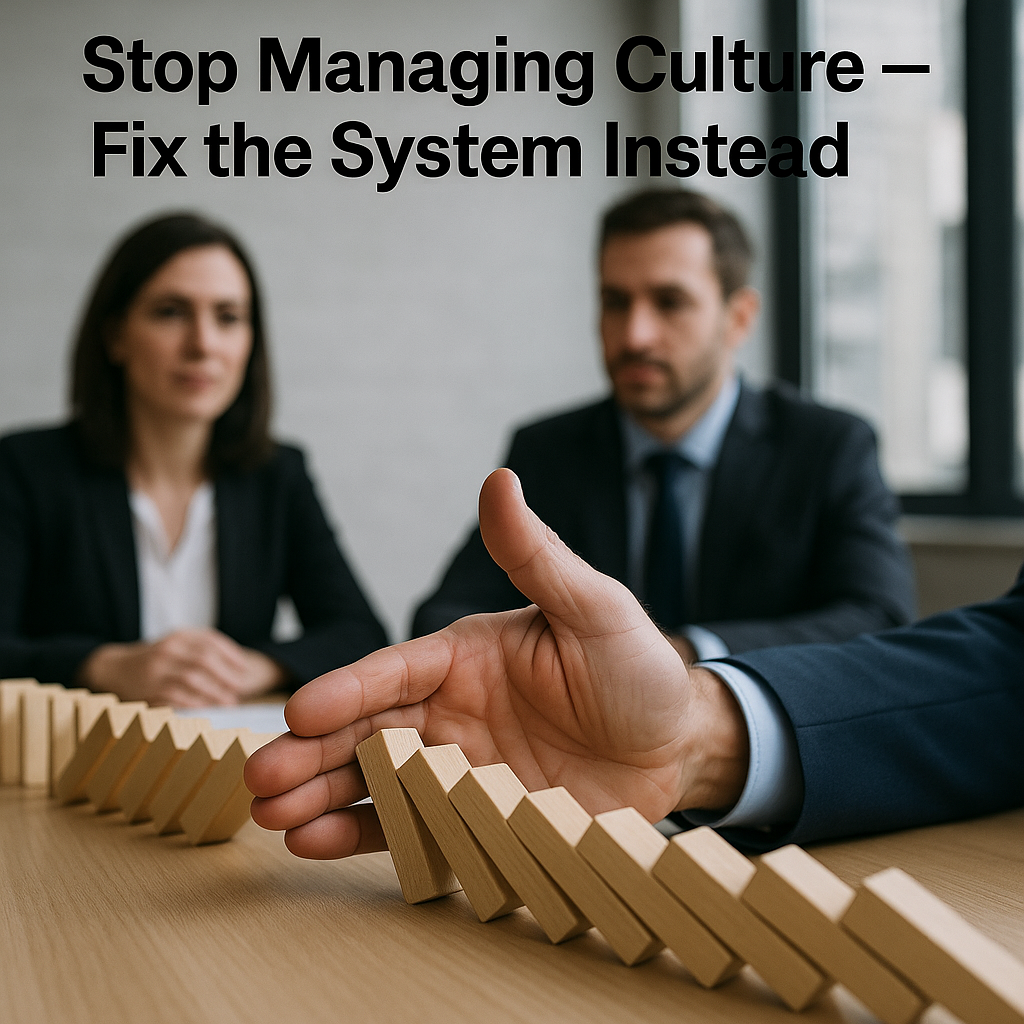
Stop Managing Culture: Fix the System Instead
- System over Mindset / System vor Mindset: Culture is a byproduct of the organizational framework; stop investing in mindset workshops and start fixing broken operating models. / Kultur ist ein Nebenprodukt des organisatorischen Rahmens; investieren Sie nicht in Mindset-Workshops, sondern reparieren Sie defekte Betriebsmodelle.
- Incentives Drive Action / Anreize steuern Verhalten: People follow the path of least resistance; behavior only changes when reward systems and performance metrics are aligned with desired values. / Menschen folgen dem Weg des geringsten Widerstands; Verhalten ändert sich nur, wenn Belohnungssysteme und Leistungskennzahlen mit den gewünschten Werten übereinstimmen.
- Simplify for Accountability / Komplexität abbauen für Verantwortung: Excessive hierarchy and bureaucracy shield mediocrity; flattening structures and ensuring radical clarity are the highest forms of leadership empathy. / Übermäßige Hierarchie und Bürokratie schützen Mittelmäßigkeit; flache Strukturen und radikale Klarheit sind die höchste Form von Empathie in der Führung.
- Architectural Transformation / Architektonischer Wandel: To achieve real change, leaders must act as architects who debug the system, removing structural friction and “sludge” to let high performance emerge naturally. / Für echten Wandel müssen Führungskräfte als Architekten agieren, die das System “debuggen” , strukturelle Reibungen und Hindernisse beseitigen, damit Höchstleistung natürlich entstehen kann.
Table of Contents
- The Trap of Cultural Theater
- Operator Truth 1: Incentives Dictate Behavior
- Operator Truth 2: Complexity Kills Accountability
- Operator Truth 3: Clarity is the Highest Form of Empathy
- Stop the Mindset Workshops
- The Operator Truths of Transformation
- Redesigning the System for Performance
- Häufig gestellte Fragen
DACH boardrooms are currently obsessed with a dangerous myth. You have heard it before. Leaders claim that organizational culture is the primary lever for transformation. They invest millions in mindset shifts, value statements, and communication campaigns, yet nothing actually changes.
The truth is uncomfortable: culture is a byproduct, not a lever. When you try to manage culture directly, you are essentially trying to fix the reflection in a mirror without touching the object itself. It is a performative distraction that allows C-level leaders to hide behind soft values because they lack the courage to fix broken operating models.
If your best people are quitting, it is not a culture problem. It is a leadership failure. You are likely running a system that rewards the wrong behaviors while expecting the right ones to magically appear through inspiration. Stop hiring consultants for mindset workshops and start looking at your structural friction.
The Trap of Cultural Theater
Many firms perform cultural theater, using outdated HR playbooks that fail to drive behavioral change. As Professor Yasin Rofcanin notes, environment dictates action. Satya Nadella proved this at Microsoft by replacing internal competition with empathy-driven performance systems. Conversely, Uber required a total structural redesign under Dara Khosrowshahi to fix toxic incentives. Real transformation requires systemic shifts; you cannot talk your way out of problems created by behavior.
Operator Truth 1: Incentives Dictate Behavior
Building on this structural foundation, leaders must recognize that you get exactly what you measure. If reward systems prioritize individual billing over collaboration, an inclusive culture remains a fantasy. Research in the Harvard Business Review confirms that employee behavior follows the path of least resistance. Organizations must align performance management with their stated values to ensure long-term success. This requires a shift from qualitative “vibes” to quantitative metrics that reward the specific behaviors you claim to value, such as knowledge sharing or cross-departmental support.
Operator Truth 2: Complexity Kills Accountability
Even with the right incentives, transformation stalls when accountability vanishes behind organizational complexity. Excessive bureaucracy serves as a shield for mediocre leadership, diluting ownership across the hierarchy and creating a “diffused responsibility” trap. Industry leaders like Goldman Sachs and CVS succeeded not through more rules, but by simplifying decision-making and removing execution friction. By flattening communication lines, these firms ensured that every employee understood their direct impact on the bottom line, effectively turning passive observers into active owners of the corporate mission.
Operator Truth 3: Clarity is the Highest Form of Empathy
Once the system is simplified, the final requirement is a radical commitment to transparency, as clarity is the highest form of empathy. True leadership means providing the precise context teams need to thrive while removing the administrative “sludge” that causes burnout. If empirical evidence reveals misallocated resources or conflicting priorities, you must immediately adjust your system parameters to “stop the bleeding.” Real innovation requires dismantling obsolete habits and providing genuine leadership support that transcends memos to reshape the daily rituals and norms governing your workplace, ensuring the system reinforces the desired culture at every touchpoint.
Stop the Mindset Workshops
Resistance to change is rarely a matter of individual stubbornness; it is almost always a rational response to misaligned incentives. When a system punishes honest mistakes while simultaneously demanding disruptive innovation, the employees aren’t the problem, the architecture is. Take the transformation of Ørsted as a blueprint: they didn’t just talk about sustainability; they completely dismantled their fossil-fuel business model and reallocated capital toward renewables. This structural pivot forced the culture to evolve out of necessity, not through posters or workshops. Leaders must stop acting like therapists and start acting like architects, redesigning the underlying machinery to ensure that the path of least resistance is also the path to high performance.
Expert Insight
“The system, to a large extent, causes its own behavior! An outside event may unleash that behavior, but the same outside event applied to a different system is likely to produce a different result.” (Donella H. Meadows)
The Operator Truths of Transformation
Dieser architektonische Ansatz bedeutet, dass echter Wandel Systemdesign statt bloßer Rhetorik erfordert. Um die tägliche Dynamik in einer Organisation grundlegend zu verändern, müssen drei operative Wahrheiten beachtet werden:
1. Incentives Dictate Behavior
Die unsichtbare Hand jeder Firma ist das Belohnungssystem. Wenn Boni ausschließlich an kurzfristige Einzelziele gekoppelt sind, wird jede Initiative für langfristige, bereichsübergreifende Kollaboration zwangsläufig an der Realität der Gehaltsabrechnung scheitern.
2. Complexity Kills Accountability
Übermäßige Hierarchieebenen und bürokratische Kontrollinstanzen verschleiern die individuelle Verantwortung. Erst durch radikale Dezentralisierung und schlanke Strukturen wird Leistung wieder messbar und für das Team sichtbar.
3. Clarity is Empathy
Anstatt in Wellness-Programme zu investieren, sollten Führungskräfte kognitive Last reduzieren. Strukturelle Klarheit über Rollen und Befugnisse eliminiert jene täglichen Reibungspunkte, die Burnout und Frustration tatsächlich verursachen.
Expert Insight
“Growing a culture requires a good storyteller. Changing a culture requires a persuasive editor.” (Ryan Lilly)
Redesigning the System for Performance
Building on these truths requires a shift from psychological interventions to technical adjustments of the organizational framework. If your goal is agility but your procurement process takes six months, no amount of “agile coaching” will bridge that gap. We must treat the organization as a product that requires constant debugging to optimize flow and output.
| System Component | Broken (Culture First) | Functional (System First) |
|---|---|---|
| Information Flow | Hoarded in silos | Radical transparency by default |
| Resource Allocation | Based on political clout | Dynamic, data-driven redistribution |
Lessons from System Redesign
Modern transformations, such as the shift observed at Microsoft under Satya Nadella, highlight the importance of “unblocking” teams. By replacing internal competition with shared engineering standards and unified platforms, the environment itself began to reward curiosity over internal dominance. Real change is codified in the organizational chart and the technical stack, not in town hall speeches. To improve the output, you must first optimize the environment in which the work happens.
Expert Insight
“Ein schlechtes System wird einen guten Menschen jedes Mal besiegen; da 85 % aller Fehler auf systemische Mängel zurückzuführen sind, muss das Management den Prozess ändern, anstatt die Mitarbeiter zu bedrängen.” (W. Edwards Deming)
Häufig gestellte Fragen
Warum scheitert der Kulturwandel meistens?
Häufig liegt es an der Diskrepanz zwischen neuen Werten und alten Metriken. Wenn das Management Agilität fordert, aber weiterhin starre Wasserfall-Budgets verabschiedet, erkennt die Belegschaft das System als “Theater” und verweigert die emotionale Beteiligung.
Wie beeinflussen physische und digitale Räume das Verhalten?
Die Architektur der Zusammenarbeit, von der Bürogestaltung bis zur Software-Architektur, bestimmt die Interaktionsrate. Werden Barrieren in der Kommunikation digital festgeschrieben, kann auch eine motivierte Führung diese Mauern nicht allein durch Zuspruch einreißen.
Was ist der erste Schritt zur Transformation?
Beginnen Sie mit einer “Reibungs-Audit”. Analysieren Sie, wo Prozesse den Fortschritt künstlich verlangsamen oder wo veraltete Richtlinien die Autonomie einschränken. Die Beseitigung dieser strukturellen Hindernisse setzt oft mehr Energie frei als jede Motivationskampagne.