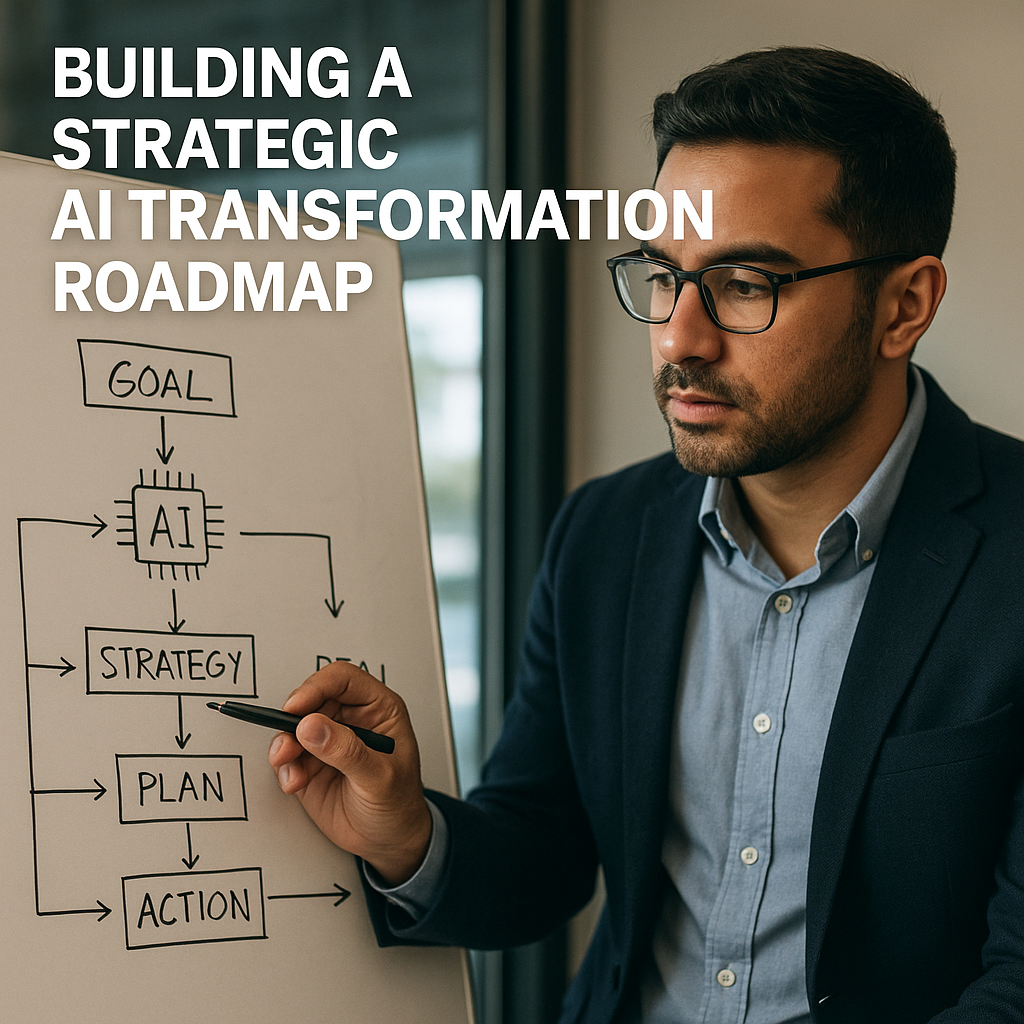
- Craft a strategic AI transformation plan anchored by a clear North Star metric, backed by governance, data quality, and a scalable operating model to turn pilots into enterprise-wide value.
- Prioritize high-impact, low-risk Generative AI use cases aligned to business outcomes, with a crawl-walk-run approach and strong data readiness.
- Decide build vs. buy thoughtfully, design a scalable AI platform architecture, and embed AI into governance, change management, and ongoing production plans.
- Define the North Star for AI
- Establish Data Governance Foundations
- Prioritize Use Cases for Generative AI
- Decide Build vs Buy for AI Components
- Design an AI-Centric Operating Model
- Build an AI Platform Architecture that Scales
- Measure Success with Clear KPIs
- Plan the Path to Production
- Embed AI into Organizational Change Management
- Governance and Data Strategy Alignment
- Industry and Function Specific AI Applications
- Risks, Pitfalls, and How to Avoid Them
- Frequently Asked Questions
- Putting It All Together
- Frequently Asked Questions
- Closing Thoughts
- Articulate a primary business outcome for AI, such as improving customer experience, accelerating product development, or reducing operating costs.
- Translate that outcome into concrete metrics you can track over time, revenue impact, cost reduction, cycle time, or accuracy improvements.
- Map those metrics to a time horizon. Short-term wins build credibility; mid-term shifts redefine workflows; long-term outcomes reshape the operating model.
- Ensure the North Star reflects strategic business outcomes, not just technical milestones.
- Link every AI program to measurable ROI and a clear operating model for adoption at scale.
- Embed governance and data quality requirements early so your AI initiatives can move from pilot to production without friction.
- Data quality and lineage: Document data sources, transformations, and quality checks so models train on trustworthy inputs.
- Data access and privacy: Define who can access what data, under what controls, and how to protect sensitive information.
- Data management and cataloging: Create a centralized view of data products, making it easier for teams to discover and reuse assets.
- Compliance and risk controls: Build guardrails for bias, explainability, and regulatory requirements from day one.
- Direct linkage to your North Star metric and business outcomes.
- Data readiness and quality for the target task.
- Speed to value and ease of adoption by teams.
- Clear success criteria and measurable ROI.
- Identify your differentiators. If you rely on unique data or deep domain insight, a custom build can matter more for sustained advantage.
- Assess time-to-value. Ready-made platforms speed deployment and governance alignment, but plan for customization to avoid generic outcomes.
- Prioritize interoperability. Ensure your choice fits your data architecture, operating model, and security posture from day one.
- Workflow redesign: Integrate AI results into decision points, not after the fact, so actions are guided by intelligent insights from the start.
- Autonomous agents and orchestration: Deploy AI agents to handle routine tasks and escalate only when human judgment is essential.
- Change management and skills: Upskill, redefine roles, and establish feedback loops so humans stay engaged where it adds the most value.
- Unified data access: A single source of truth that supports both experimentation and production workloads.
- Open standards and interoperability: Prevent vendor lock-in and enable seamless data pipelines across platforms.
- Observability and security: End-to-end monitoring, auditability, and privacy safeguards built into the stack.
- Scalability: Infrastructure that grows with data volume, user demand, and model complexity without compromising governance.
- Adoption metrics: user engagement, model usage, and cross-team collaboration.
- Business outcomes: revenue growth, cost reduction, cycle-time improvements, and quality gains.
- Operational efficiency: throughput, error rates, and automation coverage.
- Governance quality: data quality scores, bias monitoring, and compliance indicators.
- Assess readiness: Evaluate data quality, model viability, and human-in-the-loop processes for production.
- Phase rollout: Begin with controlled pilots in one function, then expand to adjacent areas with proven ROI.
- Embed governance: Establish ongoing reviews, risk controls, and model monitoring that scale with deployment.
- Institutionalize learning: Create feedback loops to refine models, data pipelines, and operating processes.
- Clear, multi-level communication: explain the rationale, the具体 changes, and the personal benefits.
- Reskilling pathways: show how AI augments roles, creating new growth tracks rather than displacing talent.
- Leadership alignment: executives demonstrate the behaviors and routines AI-enabled work requires.
- Ethics and inclusion: prevent bias, ensure fair data access, and safeguard privacy as a default practice.
- Role-based data access and risk-aware policies that reflect initiatives and ownership.
- Explicit model governance with accountable owners, risk scoring, and auditable trails.
- Embedded privacy and bias controls in every deployment.
- Continuous improvement loops tied to tangible business metrics and outcomes.
- Marketing and sales: scalable personalization, sharper lead scoring, and content optimization that boosts conversions, supported by governance and data quality controls to maintain trust across channels.
- Customer service: AI agents handle routine tasks, with humans stepping in for nuanced cases; rely on AI-assisted knowledge bases to speed resolutions.
- Operations and maintenance: predictive maintenance, demand forecasting, and supply chain optimization to cut downtime and raise service levels.
- Pivot-ready pilots: treat pilots as learning experiments with clear exit criteria and explicit pathways to scale.
- Data alignment: establish a proactive data strategy and data quality program before scaling.
- Governance continuity: maintain ongoing oversight to manage bias, privacy, and compliance as you expand.
Table of Contents
You’re not just adopting tools when you pursue AI. You’re shaping how your entire organization creates value. The roadmap you choose today becomes the operating model for tomorrow. In short, it’s a plan that ties AI to real business outcomes, with clear milestones, governance, and accountability.
This guide cuts through the hype. It offers a practical, step by step path to align AI initiatives with long term goals and measurable ROI. You’ll ground every decision in business value, not in a vendor catalog.
Define the North Star for AI
Your North Star is more than a lofty objective. It’s the bold ambition that redefines what’s possible for customers, revenue, and efficiency. Without it, pilots drift into isolated experiments that never scale.
Clarity about where AI should take you keeps everything else from spinning out of control.
Action steps you can take now:
Your North Star should sit at the center of your data strategy, governance plan, and technology choices. If you can’t tie an AI initiative to a North Star metric, you’re guessing and guessing costs you time and money.
To align with the broader AI transformation effort, keep these guardrails in view:
Transitioning from a vision to execution requires a concrete operating model. Establish who owns the metrics, how data quality is verified, and how progress is reported across functions. Your North Star should drive the decision cadence for investments, talent, and responsible AI practices.
Establish Data Governance Foundations
Good data is the engine of reliable AI. Without governance, data quality erodes, access is inconsistent, and compliance becomes a risk rather than a guardrail. You need a practical foundation that keeps data trustworthy as you scale AI adoption across the business.
In AI, data quality is not a luxury; it’s the foundation of trust and outcomes.
Lock in these governance pillars to stay on track:
Strong governance reduces rework, speeds deployment, and lowers the risk of policy violations. It also enables broader AI deployment by creating a trustworthy data environment. With solid governance, you can scale AI from pilots to enterprise-wide initiatives without losing control.
Related Video
Data Governance explained in plain english for data professionals
What is Data Governance, why is it important, why is it hard, and ways in which you can launch a lean, sustainable data governance program …
Watch on YouTube →
Prioritize Use Cases for Generative AI
Generative AI delivers value fast, but only when you apply it to the right problems. Start with high-impact, low-risk use cases that automate repetitive work or augment decision making. Take a crawl-walk-run approach to minimize risk while proving tangible value early.
Generative AI should augment work, not reinvent every process at once.
Use case criteria to guide prioritization:
Examples span marketing, sales, customer service, and operations. Start with content generation, summarization, or interactive customer support, areas where you can prove ROI quickly and then scale to more complex workflows as governance and data maturity improve. This approach supports your AI transformation and helps you move from pilot to production without losing sight of your North Star.
Related Video
Step By Step Roadmap to Become an AI Product Manager – YouTube
AI-Powered Product Management Professional Program: Simplilear… The AI Product Manager Roadmap 2026 video by Simplilearn, is …
Watch on YouTube →
Decide Build vs Buy for AI Components
You’re not choosing tools here, you’re defining how your AI capabilities will create lasting value. The decision to build customized AI components or buy off-the-shelf platforms hinges on your differentiation, time-to-value, and risk tolerance.
Built solutions can deliver a true competitive edge when you have unique data or domain expertise; ready-made platforms accelerate adoption but may trade long-term defensibility for speed.
Guiding principles to anchor your choice in the AI roadmap:
Document the decision in your AI roadmap as a living choice. It should evolve with capabilities, data maturity, and organizational needs as you scale AI adoption across the business.
Expert Insight
“In the AI era, the answer is not simply build or buy, but to own the differentiating layer and orchestrate the rest, using AI to accelerate what makes your organization unique while relying on trusted platforms for the core.” , Industry Analyst
Design an AI-Centric Operating Model
A mature transformation embeds AI into daily workflows. It’s not about adding a few AI tools; it’s about rethinking processes, roles, and decision rights so AI acts as an autonomous helper rather than a standalone project. Transitioning to an AI-centric operating model means you design end-to-end flows where AI outcomes inform decisions at the source, supported by clear ownership and accountability.
Redesigning the operating model unlocks longer-term ROI and sustains AI impact across the enterprise. Progress here often determines whether pilots translate into scalable transformation.
Expert Insight
Designing an AI-centric operating model means embedding AI outcomes at decision points, deploying autonomous agents for routine tasks, and upskilling people to stay engaged where it matters, the true path to scalable, long-term ROI. , Industry Analyst
Build an AI Platform Architecture that Scales
A robust architecture eliminates bottlenecks and governance friction. A lakehouse-style approach often strikes the right balance between data accessibility, governance, and analytics capabilities for AI programs. You want a setup that enables a smooth move from pilot to production without fighting the stack at every turn.
Platform choices are not merely technology bets; they determine how quickly you can translate work into value across the business.
Key architecture essentials you should demand:
A well-architected platform reduces friction when moving from pilot to production and enables consistent ROI realization across functions. Your design should enable data, AI capabilities, and autonomous workflows without introducing new bottlenecks.
Measure Success with Clear KPIs
You cannot manage what you cannot measure. Define metrics that link AI activities to business results, and monitor both adoption and impact. A strong measurement framework converts intent into verifiable outcomes.
Metrics should illuminate value, not clutter dashboards.
Recommended measurement areas that drive actionable insights:
Structured dashboards tied to your North Star ensure leadership sees progress, sustains investment, and aligns teams around shared objectives.
Plan the Path to Production
Turning pilots into enterprise-wide production requires more than technical readiness. It demands a deliberate, phased rollout with explicit governance, risk controls, and a transition plan for stakeholders across the business.
Scaling is a disciplined expansion, not a one-off exercise. It requires coordination across data teams, IT, operations, and business units to sustain value.
Expert Insight
Turning pilots into enterprise-wide production requires a phased rollout with explicit governance, risk controls, and a transition plan for stakeholders across the business. , Industry Analyst
Embed AI into Organizational Change Management
People drive AI outcomes. A brilliant system only succeeds when your teams embrace it. Build trust, transparency, and capability across the organization to unlock sustained value.
Honest, transparent change management turns AI into a catalyst for human performance, not a replacement narrative.
Governance and Data Strategy Alignment
From day one, your AI program must ride alongside the business strategy. Governance isn’t a hurdle; it’s the mechanism that keeps AI trusted, compliant, and scalable to deliver real value.
Governance connects data, models, and outcomes into measurable value.
Key elements to establish now:
A robust governance framework reduces surprises and accelerates safe, confident transitions from pilots to production.
Industry and Function Specific AI Applications
Different sectors demand distinct AI patterns. Craft roadmaps that target where AI can most meaningfully lift revenue, efficiency, or customer experience. The focus should be business-value first, with governance enabling scalable execution.
Selecting the right use cases within each domain accelerates ROI and demonstrates progress to stakeholders. Let business value drive prioritization while data strategy and governance enable scalable rollout.
Risks, Pitfalls, and How to Avoid Them
AI initiatives carry tangible risks. Common traps include scope drift, data gaps, and weak governance. Name risks early and bake safeguards into your plan.
Articulate risks upfront and implement concrete controls. This posture strengthens resilience and boosts the likelihood of lasting impact across the organization.
Frequently Asked Questions
What is a strategic AI roadmap?
A strategic AI roadmap is a phased plan that links AI work to tangible business outcomes. It aligns data, technology, and people decisions so you move from pilots to enterprise‑wide value. It remains anchored by a clear North Star metric and tracks governance, accountability, and progress as you mature.
How do you measure ROI from AI transformation?
ROI arises when AI initiatives translate into measurable outcomes such as revenue growth, cost reductions, and operational efficiency. Track user adoption, process improvements, and financial results against a defined KPI set in the roadmap. The goal is repeatable value at scale, not one‑off wins.
When should you scale AI from pilot to production?
Scale when data readiness is validated, governance is in place, and the redesigned workflow supports durable delivery. Begin with a controlled expansion and widen to other functions based on verified impact. This keeps momentum while avoiding novelty chasing.
What role do AI agents play in the operating model?
AI agents automate routine tasks and support decision cycles. They accelerate workflows and free people to focus on higher‑value work, while staying aligned with governance and risk controls. They enable faster, more autonomous operation of the business.
Putting It All Together
Your strategic AI transformation roadmap is a living document. It should evolve as data quality improves, governance tightens, and business priorities shift. Treat AI as a capability, not a one‑off project.
To bring it to life: define a clear North Star for AI that matches bold business goals. Build robust governance and data foundations to support trusted, scalable AI. Choose a balanced build‑ versus‑buy approach, design an AI‑driven operating model, and plan production with concrete KPIs. Translate these decisions into industry‑ and function‑specific use cases, guided by change management that engages people along the journey.
When executed well, AI becomes an integrated capability that delivers durable ROI and expands what’s possible for your business outcomes. Expect measurable gains in revenue, cost efficiency, and customer value as AI is embedded into everyday workflows and decision cycles.
Frequently Asked Questions
What is the value of a North Star for AI?
A North Star keeps the AI strategy anchored to real business outcomes. It unifies initiatives and steers investment toward measurable impact. With a clear North Star, you move from pilot ideas to scalable, customer‑facing results.
How does data governance impact ROI?
Data governance underpins ROI by improving data quality, controlling access, and ensuring regulatory compliance. Strong governance accelerates from data to decisions, reducing risk and enabling scalable gains across the organization.
What’s a practical path to production?
Begin with a controlled pilot and establish governance and data readiness from day one. As you grow, maintain explicit metrics, assign ownership, and ensure operational integration. A crawl-walk-run approach builds confidence and delivers observable business value at each stage.
Closing Thoughts
Adopting AI is about shaping how your organization creates value over the long term. The roadmap you choose informs the operating model for tomorrow, where AI aligned to business outcomes, governance, and accountability drives durable change.
Stay purposeful, stay governed, and keep your North Star in view. When you anchor projects to bold business goals, robust data foundations, and measurable ROI, AI becomes a sustained competitive advantage.
Practical cue: map every AI initiative to concrete business outcomes, embed AI into your operating model, and continuously measure adoption, impact, and value. That disciplined rhythm turns pilots into enterprise‑wide AI capabilities.